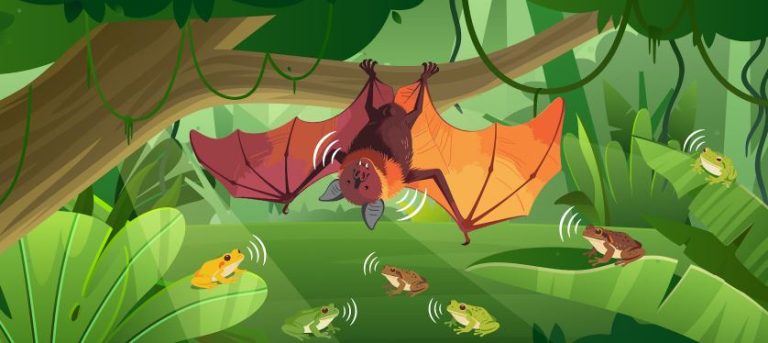
Fringe-lipped bats get better at identifying frogs and toads by their mating calls as they get older.
Introduction
There are many ways that animals find enough food to survive. Some use a strong sense of smell to sniff out their food. Others have sharp eyesight to spot prey from great distances. Others, like some bats, have good hearing.
But just because you can hear something doesn’t mean that it is food you can eat. Predators have to identify their prey to figure out if it is worth hunting. Eavesdropping is the solution some auditory predators use. They listen for sounds that prey use for other things, like attracting mates.
Fringe-lipped bats are a great example of eavesdropping predators. They eat frogs and toads. But some frogs and toads are too big to eat. They might even eat a bat if given the chance. Some are even poisonous and can make a bat sick. Big and poisonous frogs and toads are unpalatable prey. It’s helpful for bats if they can get information about possible prey before trying to attack. We know that some bats listen to the mating calls of different species of frogs and toads to get more information.
We wanted to know what information bats actually get from these mating calls. Can they figure out if frogs and toads are unpalatable? Can they distinguish between prey species? We also wanted to know if these abilities change as bats get older. Do juvenile bats react differently to calls?
Methods
To answer our questions, we looked at the behavior of fringe-lipped bats in Panama. We caught 20 adults and 19 juveniles. Then we performed an experiment to see how they reacted to different prey sounds.
We put each bat into their own enclosure. We then played a series of mating calls from frogs and toads. These were potential prey in the area.
We used calls from 12 palatable species and 4 unpalatable species. We noted the acoustic features of each call.
We also played a recording of white noise. This was our control.
We presented the calls in a random order to each bat.
We video-recorded each bat’s reactions to the sounds. To show how interested the bats were in hunting, we scored their behavior from 0 to 5 (Figure 1).
We figured out if the average bat scores for each sound were different than those for the control. Then we looked at the following:
Responses to palatable and unpalatable species of prey.
Differences between adult and juvenile responses.
If the bats’ behavior changed depending on the acoustic features of the calls.
At the end of the experiment, we released the bats back into the wild.
Results
We found that adult fringe-lipped bats had higher scores when they heard the mating calls of palatable species than unpalatable ones (Figure 2).
Juvenile bats didn’t have a clear preference for either type of call overall. But they did score highly in response to two species of poisonous toads.
We discovered that juvenile bats responded strongly to specific acoustic features. These included longer calls, lower frequencies, and calls that took longer to get loud. The calls of unpalatable species had these features more often.
Discussion
Our results suggest that bat prey preferences change over time. As bats get older, they tend to prefer more palatable prey. This is probably learned. Our data show that juveniles respond more strongly to unpalatable prey than adults do. They also respond to specific acoustic features. We think they are responding to the acoustic information about body size. We know that the calls of larger species of frogs and toads have a lower frequency because of their size. Larger frogs and toads make a bigger meal. It takes experience to learn that the largest frogs and toads are too much of a mouthful. Maybe there is some truth to the saying “older and wiser” after all!
Identifying prey is an important skill. If a bat chooses poorly, it could get ill or worse, the chosen prey might eat it! Every hunting attempt also uses up valuable energy. This energy is wasted if bats don’t catch their prey and eat a meal. Fringe-lipped bats that can correctly identify prey before they hunt are likely to stay healthy and live longer.
Conclusion
Our results suggest that juvenile bats learn to identify good prey and hunt through trial and error. Humans also learn through trial and error sometimes. Imagine a toddler learning which foods they like to eat. They need to put different foods into their mouths to taste them. There’s no way they are going to believe their parents that broccoli tastes good. What have you learned by trial and error? Maybe you can learn a new skill or how to navigate a new experience!