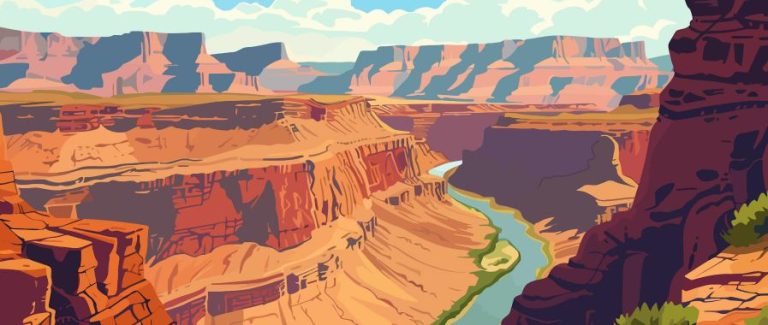
Researchers used two methods to determine the pressure experienced by rocks in the Grand Canyon to make a more detailed timeline for the area.
Introduction
The Grand Canyon is famous for its natural beauty. Layers of rock make up the canyon’s walls. These layers give the Grand Canyon its vibrant colors. Also, these same rock layers give scientists a window into Earth’s past. As we go deeper into the canyon, we find older rocks that look different than those above. Analyzing these rocks tells us how they formed and how things changed over time.
Upper Granite Gorge is a part of the Grand Canyon. It contains rocks from more than 1.7 billion years ago. The section contains seven rock blocks. Some of the blocks seem to have formed under different conditions than the others. These rocks are metamorphic. That means they experienced extreme heat and pressure. Scientists think these metamorphic rocks formed during a major mountain-building event. During this event, the movement of tectonic plates caused a volcanic island chain to collide with the ancient continent of Laurentia. The volcanic island chain became a part of Laurentia.
The blocks that make up Upper Granite Gorge experienced different temperatures and pressures. We classify some of the blocks as hot blocks and some as cold blocks. Hot blocks formed at higher temperatures than cold blocks. We wanted to determine and compare the pressure experienced by the hot and cold blocks. Also, how could these blocks be near each other if they formed under different pressure conditions?
Methods
We collected five samples from different blocks in Upper Granite Gorge (Figure 1). Two samples came from the same cold block. Three samples came from hot blocks. Then we conducted two types of analyses.
Minerals
We identified the minerals that one sample from Cold Block 1 contained. We also identified the minerals that the Hot Block 1 sample contained. We shined high-energy X-rays on each sample. The minerals in the samples then released a unique set of X-rays. We analyzed the sets of X-rays to determine which minerals the samples contained. We also used a computer program to figure out the temperature and pressure needed for this group of minerals to form.
Garnets
We analyzed garnets from all five samples. Some of these garnets had quartz crystals trapped inside. We used a special probe to determine the composition of the garnets. Then we shined a green laser on the quartz crystals. The light scattered off these crystals. We determined the wavelengths of the scattered light. Then we compared these wavelengths to the wavelength of the laser. We used how much they differed to figure out the amount of pressure the rocks experienced.
Results
Minerals
The sample from Cold Block 1 contained seven minerals. Some of these minerals were garnet, staurolite, and quartz. The highest temperature that Cold Block 1 experienced was 625°C. It experienced low to medium pressure.
The sample from Hot Block 1 contained six minerals. Some of these minerals were garnet, cordierite, and quartz. It also contained partially melted minerals. This block experienced temperatures greater than 700°C. It experienced medium to high pressure.
Garnets
Garnets and trapped quartz crystals from Cold Block 1 experienced temperatures between 530°C and 555°C (Figure 2). The pressure was about 5 kbars. The samples from Hot Block 1 and Hot Block 3 were similar. The outer layers of the garnets formed between 720°C and 730°C. This part of the garnets formed at about 7 kbars. The garnets in Hot Block 2 formed at lower pressures or higher temperatures than the other two hot blocks.
Discussion
We learned that the cold and hot blocks experienced different pressures. Cold blocks formed under pressures that were about 2 kbars lower than the hot blocks. This pressure difference tells us that the blocks were originally located at different depths. The hot blocks were deeper, causing them to experience higher pressure. But if the blocks were at different depths, how are they next to each other today?
Our analysis supports the idea that the blocks moved after they became metamorphic. That means there were two mountain-building events that occurred. The first one caused the rocks in the blocks to form. The second one caused the blocks to move.
Before we conducted this research, scientists thought that the blocks changed between 1.71 and 1.69 billion years ago. The pressure data we collected allowed us to adjust this time to an earlier range. Now we think the rocks changed between 1.75 and 1.70 billion years ago. This means that the data give a more detailed timeline for the area.
Conclusion
Studying the rocks in the Upper Granite Gorge of the Grand Canyon helped us adjust our thinking. As you explore the world around you, it is important to think like a scientist. Collect data to better understand what is happening and why it is happening. Keep an open mind and adjust your thinking as you collect more evidence about an event or situation. Remember: just like rocks change, so does our understanding of the world!