
Economics is a social science focused on understanding how individuals (microeconomics) and groups (macroeconomics) decide to allocate resources within environmental constraints. It is a field that remains difficult to grasp even for many adults, but it’s vital for students to understand how financial concerns affect policy and problem solving. The study of economics can help us understand how we end up with different outcomes for people based on seemingly subjective factors like gender or geography.
This collection highlights five scientific articles suitable for middle school and high school economics. Engage students with standards-matched adaptations, introductory video content, comprehension questions, and vocabulary to further the lesson outcomes. Each adapted article also comes with additional suggestions for activities to enhance the readers’ understanding and make the class more exciting.
1. How can we empower girls to end poverty?

Abstract: Not having enough money to buy everything we want can be disappointing. But true poverty is not having enough money for basic human needs like food, clothing, or a place to live. Governments and organizations are looking for effective ways to help people escape poverty. Some programs give people cash unconditionally – meaning it is given with no strings attached. Others give them conditional cash – for example, only if their children attend school. So which approach is more effective? We compared the impacts of unconditional and conditional cash for schoolgirls in Malawi, Africa. Unconditional cash improved girls’ well-being and reduced teen marriage and pregnancy rates. But the positive effects disappeared when the money stopped. Conditional cash led to the girls achieving more at school. Each approach has its unique benefits. We think implementing them together would be a more effective tool to fight poverty than either approach alone.
This article is suitable for high school students.
- Key terms: economics, poverty
- Scientific figures: bar graph, data table
- Scientific method: experiment, policy analysis
2. Could higher junk food taxes reduce obesity?

Abstract: Do you like eating junk food? While it might taste great, it’s highly processed food which can lead to obesity. Obesity is a problem not only in richer countries, where people have higher incomes but also in poorer countries, where at the same time many people are underweight. We wanted to see if a tax on highly processed foods could have an effect on obesity rates. To evaluate that we used import tariffs as a measurement tool and created a statistical model. We found out that increasing the price difference between healthier foods and highly processed foods could be a useful step toward reducing obesity in some countries, but could also worsen the issue with underweight, sometimes even within the same country.
This article is suitable for high school students.
- Key terms: dietary choices, economics, food security, poverty
- Scientific figures: data table, pictograph
- Scientific method: data reconstruction, policy analysis, proxy data, scientific modeling
3. How much money is stored under our feet?

Abstract: For over 100 years, scientists and economists have struggled to figure out how much money our natural resources are worth when left untapped in Nature. We addressed this problem by creating a new formula to measure the value, in money terms, of leaving natural resources in place. We then picked a case study (a real-life example) to illustrate our formulas: we investigated an agricultural area in western Kansas that grows crops using groundwater. These underground water resources are stored in the High Plains Aquifer. We thought of the aquifer like a bank account and asked how much money Kansas pulled out of its groundwater “bank account” over a period of 10 years. The number turned out to be large: $110 million per year, which is more than twice the amount Kansas spent on schools in that time! Our study shows that we have to take the value of Nature into account when planning how to use its resources in order to make wise and sustainable investments for our future.
This article is suitable for high school students.
- Key terms: economics, ecosystem services, ground water, sustainability
- Scientific figures: line graph, map
- Scientific method: case study, policy analysis, scientific modeling
4. How much do cow burps cost us?

Abstract: What do cow burps have to do with climate change or the price of meat? Scientists say that the climate on the planet is changing because of an extra layer of carbon in the Earth’s atmosphere. As it happens, all our activities release carbon – taking the bus to school, charging your laptop, eating. Yes, eating! Especially eating beef. Scientists calculated that producing 1 pound of beef results in 30 times more carbon emissions than producing 1 pound of wheat. And most of this carbon comes from cow burps! Climate change is pretty expensive for us: for example, having to pay for houses and road reconstruction after super destructive storms. As a result, some people are suggesting we should charge ourselves a small fee for doing things that release a lot of carbon. If this happens, both wheat and beef will become a little more expensive. But the increase in beef prices would be higher.
This article is suitable for middle school and lower high school students. This article includes a short, 1-minute teaser video.
- Key terms: carbon footprint, climate change, economics, farming, greenhouse gas emissions
- Scientific figures: bar graph
- Scientific method: life cycle assessment, scientific modeling
5. How does your address affect your chances of being evicted?
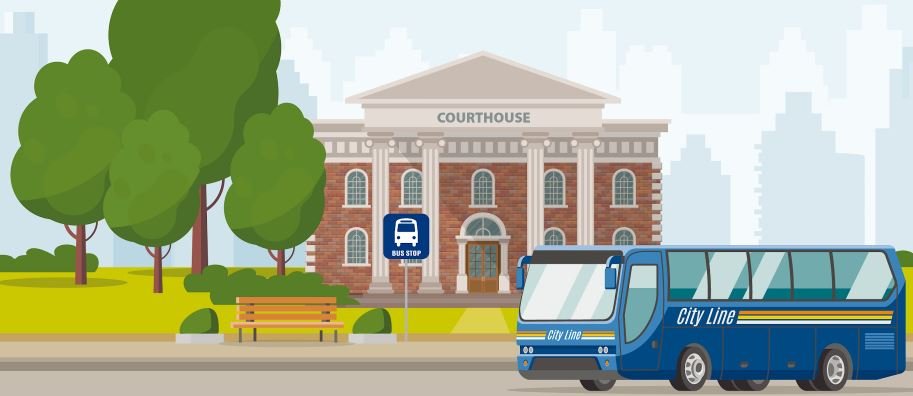
Abstract: The idea of losing your home is scary. If a renter struggles to pay their landlord, the landlord may start the legal process of eviction. The renter has the opportunity to present their case in court, but they typically must show up in person and on time. And if they don’t? In some places, the landlord will receive a default judgment. This allows them to move forward with the eviction. We wondered about renters traveling to the courthouse using public transportation. Does their travel time affect their probability of receiving a default judgment? We studied 200,000 eviction cases across fifteen years in Philadelphia, PA. We found that renters with longer travel times to the courthouse are more likely to receive a default judgment in favor of their landlord. But this effect was not present during the COVID-19 pandemic. This is because renters could attend their court hearing virtually, via video call. Our findings show that the location and accessibility of a courthouse can affect the outcomes of individual cases.
This article is suitable for lower high school students. An audio version is available in both English and Spanish, and written translations are also available in both English and Spanish. This article includes an SJK Academy Research Recap blackboard video that summarizes the article’s content.
- Key terms: economics, inequality, politics, poverty
- Scientific figures: line graph, map
- Scientific method: policy analysis
That’s Not All!
Browse our complete collection of articles on Economics.
Title image by Liza Sumner. Collection image by Mikhail Nilov.
This collection was first published on July 28, 2020. Most recent update: August 9, 2024.