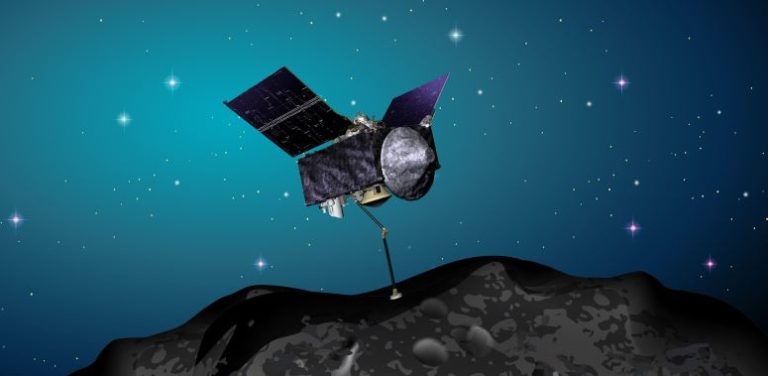
Scientists studied samples from the asteroid Bennu to determine how life-related molecules formed early on in the solar system.
Introduction
One of the biggest questions in science is “How did life start?” One way researchers study this is by looking at asteroids. An asteroid is a small rocky object that orbits the Sun. Most are billions of years old. We know that some asteroids contain ice, which melts as the asteroids slowly warm up. This process can take a million years or more and happened over 4.5 billion years ago. This allowed chemical reactions to occur. But we don’t know exactly what happens during this time. Studying this process helps scientists understand how complex materials could have formed. This could even help scientists learn about the origin of life!
In 2016, NASA sent the OSIRIS-REx spacecraft to collect rock samples from an asteroid named Bennu. Bennu is a small asteroid that passes near the Earth every 6 years. When the samples returned to Earth in 2023, many scientists were able to study them.
Our team wondered if Bennu had organic molecules that contained nitrogen. These are chemicals essential for life. We also wondered how the rocks in Bennu formed. By studying rock samples from Bennu, we hoped to learn what materials were present in space long ago.
Methods
We transported rock samples from Bennu to our laboratories. We stored them carefully to avoid contamination. We made sure they didn’t touch air, moisture, or dirt from Earth. This helped keep them just like they were in space.
We crushed the rocks gently and then separated them to look at smaller pieces. We investigated three main properties of our samples.
The elements our samples contained. We were especially interested in elements like nitrogen, carbon, and oxygen. We used a transmission electron microscope technique to figure this out.
How the elements were arranged. We used infrared light and X-rays to help us see what chemical bonds our samples contained. This could help us determine what types of molecules were in our samples.
The microscopic structure of our samples. We used a beam of ions to shave layers off our sample. Then we used our microscope to help us see small internal structures. That helped us discover how the rock changed as it formed.
Results
We found that our Bennu samples contained a lot of nitrogen, carbon, and oxygen. These elements are important for forming complex molecules that support life.
We found chemical groups with bonds between:
carbon and oxygen
carbon and nitrogen
carbon and hydrogen
nitrogen and hydrogen
oxygen and hydrogen
Many of these chemical groups are also found in plastics and life here on Earth.
Some of our samples seemed smooth and flexible as we prepared them for our microscope scans (Figure 1). We found that our samples contained tiny crystals made of calcium, carbon, and oxygen trapped inside multiple layers. The shape of the layers suggests that they were deposited on surfaces at some point.
Discussion
The plastic-like material inside Bennu is rare! It gives us a glimpse into how Bennu changed over time. We found carbon- and nitrogen-rich layers that had tiny crystals inside. When Bennu first formed, it was most likely frozen. Later, it heated up, and the water ice in the asteroid melted. The rare material we found probably did not form in water. Water would have separated the elements differently. That means it formed before liquid water was present, while Bennu still had ice! So, it formed through cryogenic reactions, or reactions that occur at very cold temperatures.
The shape of the layers suggests that water later pushed the plastic-like material around and mixed it with the crystals. It is possible that the chemical bonds also changed a little bit from sitting in the water. This could explain how the layers in our samples formed (see Figure 2 on p.3).
Our discovery shows that complex chemical reactions happened in space a long time ago. The presence of carbon, nitrogen, and oxygen is especially interesting. Molecules containing nitrogen, like amino acids, are essential to life on Earth. One hypothesis is that these essential molecules originally came from asteroids that crashed into Earth. Our findings show that these types of molecules can form on asteroids. But a lot more research will be needed to fully understand where these essential molecules on Earth came from. Hopefully, further research about what asteroids are made of can help!
Conclusion
We are still figuring out how life formed in the early Solar System. Scientists study materials here on Earth to understand how they change over time. These skills help them investigate materials found in asteroids like Bennu, which formed far away in space. You can do the same by comparing what you learn at home or in school with what you observe in the world around you. By staying curious and exploring science, you could one day help answer some of the biggest questions about life on Earth.