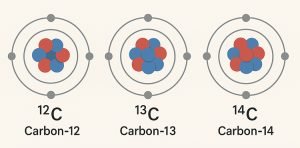
We’ve put together this collection of 6 scientific articles perfect for teaching isotopes in chemistry class. Each article is adapted from an academic research paper published in a peer-reviewed journal, re-written for students, and reviewed by the researcher. Each contains an introductory video as well as questions to assess the students’ understanding.
1. How did the Maya civilization react to climate change?
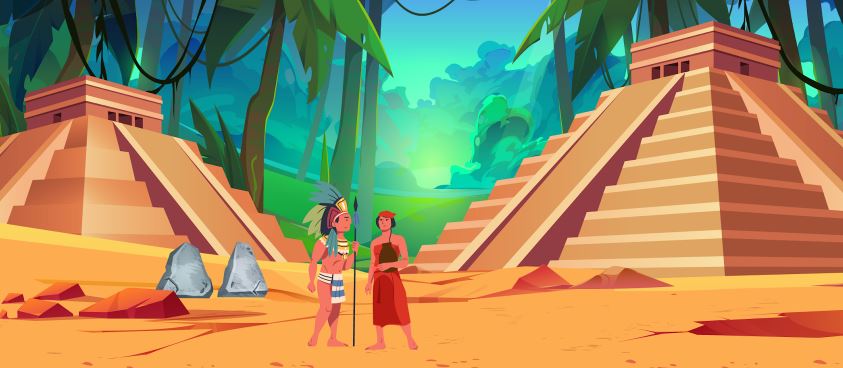
Abstract: Do you choose to do different activities on rainy days and sunny days? Much like we react to the weather day to day, humans also respond to the climate. The climate is the long-term pattern in weather. Changes in climate, such as long droughts, can affect how people live. It can even impact whole civilizations. We wanted to find out whether climate change affected the Classic Maya civilization. This civilization lived in Mesoamerica over a thousand years ago. We studied the layers of a stalagmite pillar from a cave. These layers showed evidence of long, severe droughts. Soon after, the Maya people abandoned their cities in the area. We think the droughts might have forced people to leave and caused their political systems to collapse.
- Key term: archaeology, climate change, drought
- Scientific figures: time series graph
- Scientific methods: climate scenarios, field study, isotope analysis, microscopy, proxy data, representative sampling
- Additional resources: Spanish translation, SJK Academy blackboard video, Audio Edition (English), Lesson Idea video
2. What kinds of foods did Neanderthals eat?
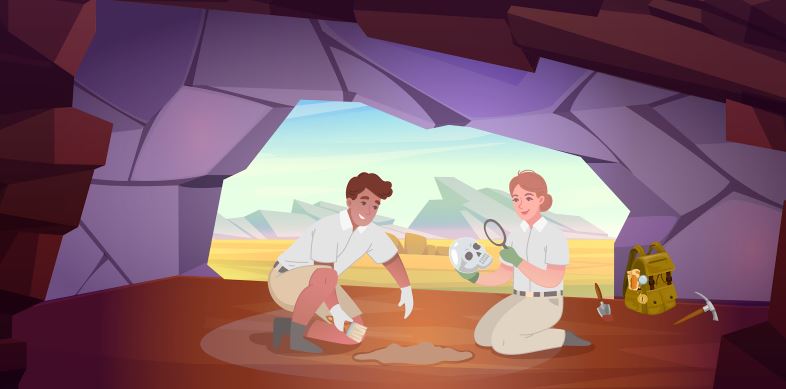
Abstract: Have you ever wondered what people in the Stone Age had for dinner? Food back then was very different from today! People gathered wild foods and hunted animals to eat. Scientists want to know what people ate long ago because it helps explain how people survived in difficult conditions. In the Stone Age, Neanderthals and modern humans (our species!) both lived in Europe. We don’t know why Neanderthals went extinct and why modern humans survived. Learning about what Neanderthals ate can help us answer this question. We tested a new method where we measured isotope ratios in tooth enamel. We learned that meat was a big part of Neanderthals’ diet!
- Key term: archaeology, dietary choices, extinction, food chain
- Scientific figures: map, scatter plot
- Scientific methods: experiment, isotope analysis, representative sampling
- Additional resources: Audio Edition (English)
3. What can we learn from carbon on Mars?

Abstract: Mars is currently dry and cold and doesn’t have much of an atmosphere, but what was it like in the past? Did Mars ever have a climate or environment that could support life? Luckily, we have rovers on Mars that can help us investigate! We used the Curiosity Rover on Mars to sample the planet’s surface where there might have been a lake long ago. We looked at the carbon in our sample to see how much there was and where it came from. This could give us clues about what the environment was like and if there used to be organisms living in the area. Our data suggest that there is more carbon on Mars than we had expected. Most of the carbon came from meteorites and volcanic rock. We can’t rule out that it came from living things, but we need a lot more information to help us figure it out.
- Key terms: dual reading level, geology, molecular biology, space travel
- Scientific figures: bar graph
- Scientific methods: experiment, field study, isotope analysis, mass spectrometry, proxy data
- Additional resources: Lower reading and upper reading level adaptations, Spanish translation, Audio Edition (English)
4. What can tusks tell us about the lives of mastodons?

Abstract: Did you know that tusks are enormous teeth? Many animals have them, but the biggest ones belong to elephants and their relatives, including mastodons. Mastodons are now extinct, but paleontologists can use fossil tusks to study the lives of these ancient giants. For our study, we analyzed the right tusk of a male mastodon found in 1998. We also analyzed two chemical elements preserved in the tusks: oxygen and strontium. Using different forms of these elements (called isotopes), we tracked the season when a particular layer of tusk was grown, as well as where he grew it. We learned that he traveled long distances to mate with females. He also had fights with other mastodons and even died during his final battle!
- Key term: extinction, fossils, migration, paleontology
- Scientific figures: map. pictograph
- Scientific methods: data reconstruction, isotope analysis, mass spectrometry, proxy data, representative sampling, scientific modeling
- Additional resources: Audio Edition (English)
5. What happens to plastic in the soil?

Abstract: Can you think of life without plastic? Plastic is currently one of the most common materials. It’s used for most containers and it’s even in your clothes! But what happens to this plastic? Some gets recycled but a lot of it gets thrown away. That means it often ends up in the environment where it can break down and change. We wanted to see what happens to different types of plastic when we exposed them to different types of soil. We put small disks of plastic in different environments for 32 days. We then compared the plastics exposed to soil to plastic that was not exposed to soil to see how the surface and other properties changed. We also wanted to see whether any bacteria grew on the plastic. Our data proved that all plastics change when exposed to soil. But they experience different changes because they have different properties.
- Key term: microbiology, plastic, waste
- Scientific figures: microscopy image
- Scientific methods: experiment, isotope analysis, mass spectrometry, microscopy
- Additional resources: French translation, Audio Edition (English), Ask-A-Scientist interview
6. How does climate change affect the Great Lakes?

Abstract: Scientists agree that some human activities, like burning fossil fuels, cause the Earth’s atmosphere to trap more heat, leading to climate change. We wanted to find out how climate change affected large freshwater lakes, so we took a series of sediment cores in Lake Superior (the biggest of the Great Lakes in North America) to study samples of the mud at the lake bottom. Back in the lab, we analyzed tiny bits of dead plants and algae trapped within the sediments. From these samples, we could see that the amount of algae in Lake Superior has slowly increased over time. However, in the past hundred years, the amount of algae and plants in the Lake has increased dramatically. We think this recent drastic change happened because human-caused climate change led to warmer temperatures and longer ice-free periods in the lake. This made it easier for algae and plants to grow in the water.
- Key term: climate change, habitat, lake, species distribution
- Scientific figures: map, time series graph
- Scientific methods: experiment, isotope analysis, representative sampling, tree core sampling
- Additional resources: none
That’s Not All!
Check out our complete collection of adapted research articles about isotope analysis or chemistry, and this original hands-on lesson plan teaching students about chemical reactions through a game of cup pong.
See also the rest of our collections.
Happy science exploration!
If you come across any issues with this collection, please let us know by emailing editor @ sciencejournalforkids.org.
Last updated: Oct 2026
Title image by Stanford Advanced Materials.