Baking bread and raising oil-eating bacteria have something in common: both are forms of biotechnology! Biotechnology applies what we learn about DNA to create new tools from living organisms for use in agriculture, medicine, manufacturing, and other fields. The field has grown since the 1970s with advances in gene sequencing, and scientists have already developed biodegradable plastics and vaccines using biotechnology.
Challenge students to explore the field of biotechnology with this collection of six adapted research articles. Engage students with standards-matched adaptations, introductory video content, comprehension questions, and vocabulary to further your lesson outcomes. Each adapted article also comes with additional suggestions for activities to enhance the readers’ understanding and make the class more exciting.
Genetic Editing and GMO
1. How can we save bananas from a deadly disease?

Abstract: Have you ever wondered why all bananas in supermarkets look alike and taste exactly the same? Because almost all exported bananas (Musa spp) are of a single cultivar, the Cavendish. Every single Cavendish is genetically identical; basically, they are all clones! So what? Cavendish bananas are under a threat from a disease called Panama disease, also known as Fusarium wilt Tropical Race 4 (TR4) that is caused by a fungus. It is spreading very fast and has already destroyed many plantations in Asia and Australia and has recently spread to the Middle East and Africa. This is because Cavendish bananas do not have an active gene to fight off TR4. However, a wild banana from Indonesia does – the RGA2 gene. Here, we added the RGA2 gene to Cavendish plants and tested them in fields infested with TR4. Three years later, some of these genetically modified (GM) plants resisted the fungus and stayed disease-free. That means we may have found a solution to control TR4 and help millions of people who rely on bananas for food and income.
This article is suitable for high school students.
- Key terms: banana, biotechnology, food security, fungi, genetics, molecular biology, plants
- Scientific figure: bar graph
- Scientific method: experiment, field study, gene editing
2. How can we use genetic editing to get rid of malaria for good?

Abstract: Nobody likes the buzzing sound or itchy bite of mosquitoes. But mosquito bites (only females bite, by the way!) are not just irritating: they can carry and spread deadly diseases such as malaria, dengue, yellow fever and many more. Every year, millions of people die from mosquito-borne diseases and most of them are young children. There are ways to get rid of mosquitoes and prevent such diseases, but they are not as effective as we would like. What if we used genetic engineering? Here we modified the genetic makeup of Anopheles gambiae mosquitoes (the main carriers of malaria). The mutation prevented females from biting and laying eggs. It spread through our caged populations quickly and drove them extinct. Our results pave the way for lowering mosquito populations in the wild and getting rid of malaria in the future.
This article is suitable for high school students.
- Key terms: biotechnology, genetics, infectious diseases, malaria, molecular biology, mosquitoes, vector borne diseases
- Scientific figures: pictograph, time series graph
- Scientific method: CRISPR, data validation, experiment, gene editing, scientific modeling
Better Medical Treatments
3. How can gene editing cure a disease?

Abstract: Did you know that the cell copies 50 nucleotides (letters of DNA code) per second when it is dividing? And it only makes one mistake per 100 million nucleotides! That’s like copying the full 32 volumes of Encyclopedia Britannica twelve times and only making one typo! Most times even these mistakes are caught and fixed. But sometimes a mutation (mistake in the code) gets passed on. In eggs and sperm that means an unborn baby will get one bad copy of that gene. In most cases, even this is okay. The baby is a carrier of a bad copy of the gene, but often the good copy from the other parent will work well enough. In rare cases, though, a baby may receive a bad copy from both parents. This means they will have a genetic disease. There are several diseases that are caused by a single nucleotide mutation. Scientists have always wanted to use genetic editing to correct the bad part of the gene. We found a way to do it in real, live mice!
This article is suitable for high school students. A written translation is available in Korean.
- Key terms: biotechnology, genetics, molecular biology
- Scientific figures: box and whisker plot
- Scientific method: DNA sequencing, experiment, fluorescence imaging, gene editing
4. How can we outsmart Zika virus?

Abstract: The mosquito-transmitted Zika virus has been in the news a lot lately. Do you know what scientists are doing to protect us from it? When the virus infects pregnant women, it can cause neurological defects in their unborn children. Microcephaly (abnormally small heads) is the worst defect caused by Zika. Currently, there is no cure or vaccine preventing Zika infection. It is hard to develop a vaccine because of a special feature of this virus and its close relatives called antibody-dependent enhancement (more on that later). That’s why we decided to try a new approach against this virus. Instead of a vaccine, we wanted to introduce “ready-to-go” antibodies that could neutralize the infection. We first found a patient with a natural, strong immune response against Zika virus. We then identified the antibodies that were responsible for this antiviral effect and produced them in the lab. Then, we gave the purified antibodies to four macaques monkeys and injected the animals with Zika virus to see if this treatment can prevent virus replication. Our experiment showed promising results – we found no trace of the virus in the antibody-treated macaques.
This article is suitable for high school students.
- Key terms: biotechnology, disease control, immunity, infectious diseases, microbiology, mosquitoes, vector borne diseases
- Scientific figures: line graph, time series plot
- Scientific method: cell culture, ELISA, experiment, PCR (polymerase chain reaction)
Bacteria Can Make Useful Stuff For Us
5. Can we use bacteria to make renewable rocket fuel?

Abstract: NASA’s space shuttle has to reach speeds of almost 18,000 miles per hour (29,000 kilometers per hour) in only 8.5 minutes. That’s necessary for it to reach outer space. That’s 300 times faster than a car traveling at 60 mph (97 km/h)! To reach these speeds, rockets need particularly high-energy fuels. It’s the same for airplanes and cargo ships, too. At the moment, these high-energy fuels are made using petroleum – a fossil fuel, and the leading cause of global climate change. So, there’s an urgent need for scientists to develop more sustainable high-energy fuels. We explored whether bacteria could make molecules we could turn into high-energy biofuels. We looked into bacterial DNA and used clever chemistry to produce new biofuels using Streptomyces bacteria. These “POP biofuels” seem to be even better (higher energy) than the current petroleum-made rocket fuels!
This article is suitable for elementary school, middle school, and high school students. This article comes with both an upper reading level and a lower reading level adaptation. Audio versions are available in English and Spanish, and a written translation is available in Spanish.
- Key terms: aviation, biotechnology, climate change, dual reading level, fuel, genetics, microbiology, renewable energy, space travel
- Scientific figures: bar graph, pictograph
- Scientific method: experiment, gene editing, PCR (polymerase chain reaction)
6. How can we find oil-eating bacteria to clean up the sea?
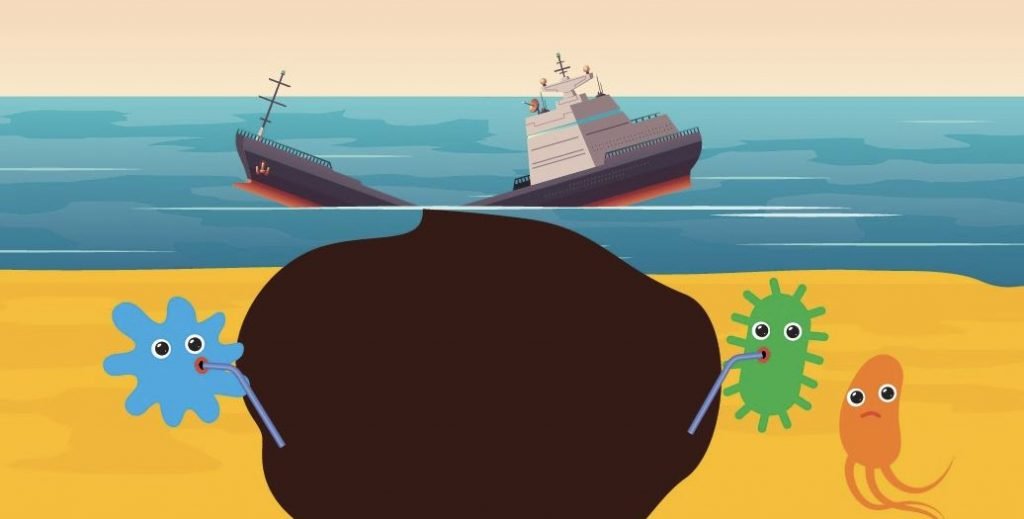
Abstract: Crude oil is widely used in our everyday life to produce plastics, streets, fuel, and other items. Unfortunately, oil is toxic to plants and animals (including humans). If it gets spilled, for example in a transportation accident, it needs to be cleaned up to prevent damage to the environment. One way to do this is to use bacteria that eat oil. But methods to find these special bacteria are very expensive and take time. Consequently, other methods are often used for cleaning up. The problem is that those other methods also harm the environment – just not as much as oil does. We wanted companies to be more willing to use the environmentally friendly oil-eating bacteria for clean-ups. We developed an inexpensive test to identify these special microorganisms. If companies can pay less, they are more likely to use these bacteria and be kinder to the environment while they’re at it!
This article is suitable for middle school students. A written translation is available in Bulgarian.
- Key terms: biotechnology, microbiology, oil spill, restoration ecology
- Scientific figures: bar graph, pictograph
- Scientific method: cell culture, experiment, fluorescence imaging, microscopy
That’s Not All!
Check out all of our adapted research articles about Biotechnology, Genetics, and Molecular Biology.

Title image by Mikhail Nilov