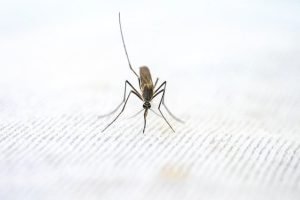
Mosquitoes live all over the world. There are more than 3,000 species of them! We know them best for the annoying, itchy bites that come from an allergic reaction to their saliva. Now, most mosquitoes feed on sugar sources, like any other flying insect. But female mosquitoes will bite people when seeking animal blood for their reproductive processes. And unfortunately, some mosquitoes are vectors for diseases like malaria, dengue, Zika, West Nile, and other pathogens that cause serious problems or death in humans. Because mosquitoes are such a problem worldwide, there is a lot of interesting research about them.
This collection highlights five scientific articles about managing our relationship with mosquitoes through bio-engineering, tracking, and even manufacturing special clothing. Engage students with standards-matched adaptations, introductory video content, comprehension questions, and vocabulary to further the lesson outcomes. Each adapted article also comes with additional suggestions for activities to enhance the readers’ understanding and make the class more exciting.
1. How can bacteria stop dengue?

Abstract: Vector-borne diseases are a major threat to human health. Diseases caused by viruses and parasites carried by mosquitoes kill millions of people every year. How can we control these diseases? One of the methods scientists have tried to develop recently is biocontrol – the use of natural enemies to control mosquito populations and thus the diseases they carry. We wanted to try a slightly different approach: using bacteria that reduce the mosquitoes’ ability to transmit viruses. We introduced these bacteria in local Australian mosquitoes and then released them back into a town where a lot of dengue outbreaks have occurred to breed with wild mosquitoes. Soon enough the majority of the mosquitoes in the area carried the bacteria. This has led to a drastic reduction of human dengue cases.
This article is suitable for middle school and high school students. It is available in UPPER and LOWER reading levels.
- Key terms: disease control, dual reading level, infectious diseases, microbiology, mosquitoes, outbreak, vector borne diseases
- Scientific figures: histogram, pictograph, time series graph
- Scientific method: case study, data validation, PCR (polymerase chain reaction), representative sampling
2. How can we use genetic engineering to get rid of malaria for good?

Abstract: Nobody likes the buzzing sound or itchy bite of mosquitoes. But mosquito bites (only females bite, by the way!) are not just irritating: they can carry and spread deadly diseases such as malaria, dengue, yellow fever and many more. Every year, millions of people die from mosquito-borne diseases and most of them are young children. There are ways to get rid of mosquitoes and prevent such diseases, but they are not as effective as we would like. What if we used genetic engineering? Here we modified the genetic makeup of Anopheles gambiae mosquitoes (the main carriers of malaria). The mutation prevented females from biting and laying eggs. It spread through our caged populations quickly and drove them extinct. Our results pave the way for lowering mosquito populations in the wild and getting rid of malaria in the future.
This article is suitable for high school students.
- Key terms: biotechnology, genetics, infectious diseases, malaria, molecular biology, mosquitoes, vector borne diseases
- Scientific figures: pictograph, time series graph
- Scientific method: CRISPR, data validation, experiment, gene editing, scientific modeling
3. Can graphene in your clothing stop mosquito bites?

Abstract: Wouldn’t it be great if there was clothing out there that could fully protect us from mosquito bites? This could reduce itching and the spread of mosquito-borne diseases. To find out, we tested whether a super thin but really strong substance, graphene, has the potential to make clothing mosquito proof. In a lab experiment, we exposed humans wearing a) no protection or b) cheesecloth or c) cheesecloth plus graphene to mosquitoes. And we found that the graphene indeed kept mosquitoes from biting people. We were surprised to realize that it not only acted as a physical barrier for the insects’ mouthparts but also blocked important chemical signals that mosquitoes use to detect humans. Under dry conditions, our graphene layer, therefore, showed double potential for protection. However, sweat or water made it less mosquito-proof. But we found a modified form, “reduced graphene”, that protected humans even when it was wet.
This article is suitable for middle school students. A written translation is available in Bulgarian.
- Key terms: disease control, insects, mosquitoes, vector borne diseases
- Scientific figures: bar graph
- Scientific method: experiment, observation, scientific modeling
4. Can we smell malaria?

Abstract: Malaria is one of the deadliest diseases in the world. People get infected through a mosquito bite after which the symptoms can vary from a mild feverish disease to a deadly one. There are some people though who don’t develop any symptoms – but they can still transmit malaria. This makes it more difficult to control the disease as there are more infected people out there than it appears. Other researchers have discovered that malaria can change people’s odor in order to attract mosquitoes. We wanted to see if we could use these changes to identify malaria cases. We collected odor and blood samples from approximately 400 children from Kenya. We observed different odor patterns in children who were infected with malaria and showed symptoms, those who were infected but did not have symptoms, and uninfected children. Using these patterns we were able to predict who has malaria and who does not, regardless of whether they showed symptoms.
This article is suitable for middle school and high school students.
- Key terms: biotechnology, disease control, infectious diseases, insects, malaria, mosquitoes, parasites, vector borne diseases
- Scientific figures: microscopy image, scatterplot
- Scientific method: chromatography, data validation, mass spectrometry, microscopy, PCR (polymerase chain reaction), proxy data, representative sampling, scientific modeling
5. How can we track mosquitoes? (And why!)

Abstract: Mosquitoes aren’t just annoying, they can carry deadly diseases as well. The main way to control these diseases is by controlling mosquito populations. In order to do that, we have to study the ecology of these populations; we have to track the mosquitoes. Mark-release-recapture (MRR) is a great method to estimate the population’s size and other information. Mosquito MRR experiments, however, have some limitations as these insects are really small and have short lives. We present mathematical models that address these limitations. Our results indicate a good estimation of the population abundance (number of mosquitoes in a given area).
This article is suitable for high school students.
- Key terms: disease control, insects, mosquitoes, vector borne diseases
- Scientific figures: bar graph
- Scientific method: data extrapolation, mark-release-recapture, representative sampling, scientific modeling
That’s Not All!
Browse our complete collection of adapted scientific articles on mosquitoes, malaria, and insects.
Check out especially our latest article on the anti-malaria vaccine: How helpful is the R21 malaria vaccine?

Title image by Pragyan Bezbaruah.
Last updated: Oct 2024. If you come across any issues with this collection, please let us know by emailing editor @ sciencejournalforkids.org.