Who doesn’t love dinosaurs? The largest land animals known to exist, dinosaurs have been fascinating to humans since the first fossils were discovered in the 1800s. Help students explore these ancient creatures from the basis of real scientific research. Engage students with standards-matched adaptations, introductory video content, comprehension questions, and vocabulary to further your lesson outcomes. Each adapted article also comes with additional suggestions for activities to enhance the readers’ understanding and make the class more exciting.
1. What can we learn about dinosaur skin using a laser?

Abstract: Have you ever wondered how we know what dinosaurs looked like millions of years ago? We analyze fossils! When you think about dinosaur fossils, you might think about bones and footprints. But sometimes fossils contain pieces of skin. One example is the Psittacosaurus fossil located in a German museum. Many scientists examined the scaly skin of this specimen. We then re-examined this fossil using a technique called laser-stimulated fluorescence. This technique helped us gather information that was not visible under normal light. We found that the shape and size of the scales of the Psittacosaurus are not the same everywhere. We also learned that there are patterns in the scales. These patterns are unique to the family of dinosaurs to which the Psittacosaurus belongs.
This article is suitable for lower high school students. An audio version is available in English. This article includes a Lesson Idea video to engage students in learning about dinosaur evolution.
- Key terms: dinosaurs, fossils, paleontology
- Scientific figures: microscopy image
- Scientific method: experiment, fluorescence imaging
2. How can we know about dinosaurs’ social lives?

Abstract: Fossils tell us a lot about how dinosaur shapes changed over time. But learning how dinosaur behavior changed over time is a lot harder to do! That’s why we were so excited to find a treasure trove of Mussaurus patagonicus fossils in Patagonia in southern Argentina. We found fossils of eggs, hatchlings, juveniles, and adults. Mussaurus lived in the early Jurassic, about 193 million years ago. It is an early cousin of the giant sauropods like Diplodocus. Clues from our fossil find tell us about Mussaurus’ social lives. They lived in herds, nested in colonies, and spent time in age-separated groups. This is the oldest fossil evidence of dinosaur social behavior ever found!
This article is suitable for middle school and lower high school students. An audio version is available in English. This article includes a Lesson Idea video to engage students in learning about dinosaur social behaviors.
- Key terms: animal behavior, dinosaurs, fossils, paleontology
- Scientific figures: map, pictograph
- Scientific method: field study, observation, scientific modeling, tomography scans
3. How could baby dinosaurs live in the Arctic?
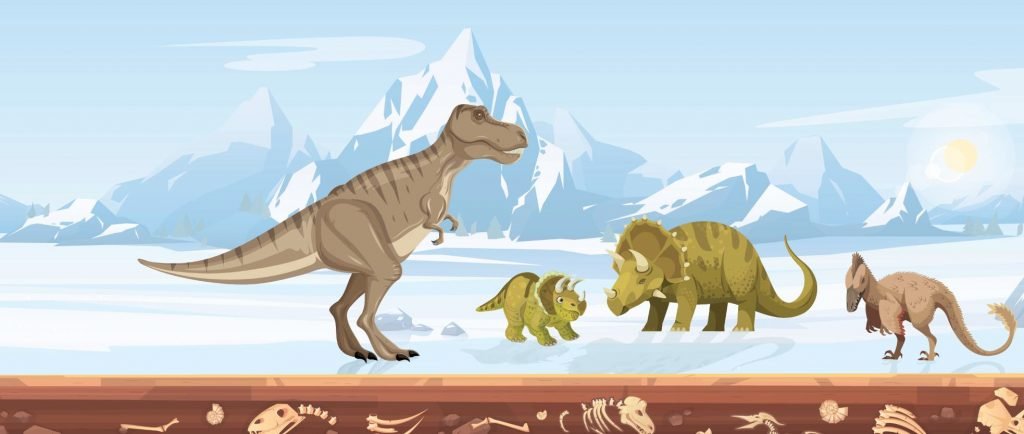
Abstract: Scientists never thought that dinosaurs lived in the Arctic and Antarctic. But they were wrong! In the 1960s we started discovering dinosaur remains in these harsh environments. Scientists wondered whether dinosaurs lived there year-round. Could they have survived the freezing, dark winter? If they did, then dinosaurs must have laid eggs and babies must have been hatched there. So, we went digging for evidence of dinosaur reproduction in the Arctic. We went to northern Alaska to study rocks in the Prince Creek Formation. We searched through the sediment looking for tiny dinosaur bones and teeth. We found evidence of very young dinosaurs in the Arctic and even baby bones and teeth from the time before they hatched. And not one dinosaur species, but seven! Both large and small species of dinosaurs lived there all year. These dinosaurs must have been well-adapted to life there. It is possible they hibernated or fasted to survive the harsh winter.
This article is suitable for elementary school and middle school students. An audio version is available in English and a written translation in both English and Bulgarian.
- Key terms: dinosaurs, fossils, migration, paleontology
- Scientific figures: map, pictograph
- Scientific method: climate scenarios, field study
4. Where did flying reptiles come from?

Abstract: Have you heard of flying dinosaurs named pterodactyls [terr-oh-dak-tlz]? Well, you may be surprised to hear that they are not technically dinosaurs. Pterodactyls, part of the group pterosaurs [terr-oh-sorz], were reptiles. They were related to dinosaurs, which are also reptiles, but do not belong to that group. Pterosaurs were the first vertebrates that were able to fly by flapping their wings. This makes them all the more interesting. Have you ever thought about how it is possible that some animals started to fly? How did they get their wings? The general answer is: evolution. But here the mystery deepens. For a long time it seemed like there was a huge evolutionary gap between pterosaurs and most other animals. How did they come about? By looking at fossils, we found out that lagerpetids [la-jer-pe-tids] (a small group of non-flying reptiles) are close relatives of pterosaurs. Finding out about lagerpetids told us a bit about how pterosaurs started to fly.
This article is suitable for middle school and lower high school students. An audio version is available in English. This article includes a Lesson Idea video to engage students in learning about dinosaur anatomy.
- Key terms: dinosaurs, evolution, fossils, paleontology, reptiles
- Scientific figures: pictograph
- Scientific method: experiment, tomography scan, X-ray scanner
5. What can fossils tell us about the nervous system’s evolution?

Abstract: What can we learn from fossils? We can estimate the shape and size of an extinct animal. Anything else? Well, if soft tissues (like the brain or muscles) fossilize, it could tell us how the animal functioned or behaved. Unfortunately, soft tissue decomposes quickly after an animal dies. They aren’t preserved as fossils very often. That’s why we felt really lucky when we came across a fossil of an extinct horseshoe crab with a preserved central nervous system (CNS). We discovered that the organization of the CNS in our fossil is the same as in horseshoe crabs living today. It hasn’t changed in over 300 million years! We also figured out how our unique fossil might have formed. This could help others discover similar fossils in the future.
This article is suitable for middle school and lower high school students. An audio version is available in English. This article includes a Lesson Idea video to engage students in learning about this unique fossil, and an Ask-A-Scientist interview with the original researcher, Dr. Russell Bicknell.
- Key terms: evolution, fossils, neuroscience, paleontology
- Scientific figures: pictograph
- Scientific method: microscopy, observation
6. What can tusks tell us about the lives of mastodons?

Abstract: Did you know that tusks are enormous teeth? Many animals have them, but the biggest ones belong to elephants and their relatives, including mastodons. Mastodons are now extinct, but paleontologists can use fossil tusks to study the lives of these ancient giants. For our study, we analyzed the right tusk of a male mastodon found in 1998. We also analyzed two chemical elements preserved in the tusks: oxygen and strontium. Using different forms of these elements (called isotopes), we tracked the season when a particular layer of tusk was grown, as well as where he grew it. We learned that he traveled long distances to mate with females. He also had fights with other mastodons and even died during his final battle!
This article is suitable for middle school students. An audio version is available in English.
- Key terms: extinction, fossils, migration, paleontology
- Scientific figures: map, pictograph
- Scientific method: data reconstruction, mass spectrometry, proxy data, representative sampling, scientific modeling
That’s Not All!
Browse our complete collections on Dinosaurs, Fossils, Paleogenetics, and Paleontology.
Title image by Tanya Dimitrova of a mastodon’s skeleton at the Natural History Museum, London.