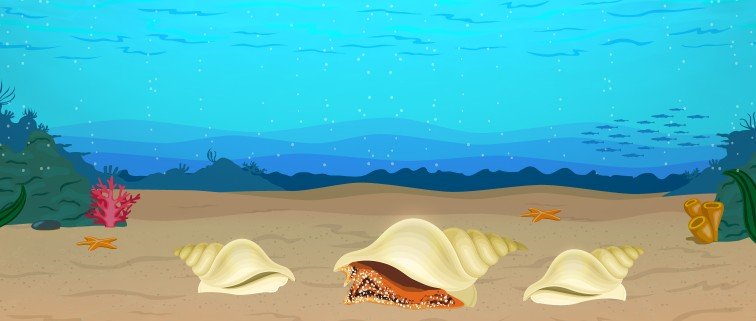
Scientists wanted to find out how sea snails were adapting to new habitats in colder waters.
Introduction
Imagine being a tiny baby snail out in the huge ocean. Just floating around for months until you find a nice place to grow into an adult. Like thousands of other marine species, that’s what happens to Kellet’s whelk babies.
But something interesting is happening to where these baby sea snails end up. In the past, Kellet’s whelks lived only in the warm waters of Southern California and Mexico. But in recent years, some of the snails have moved 300 kilometers north. That’s like moving from Washington, D.C. to New York City! And the water is colder up north.
Snails, like all living things, have DNA. DNA makes up genes that carry special instructions. These instructions make us and the snails unique. It is why you and your friend may have different hair colors. The DNA in genes sometimes changes – this is called a mutation. Sometimes, a mutation happens that helps animals survive better in new places. Scientists call this adaptation.
How can we tell when an animal has adapted to its habitat? Sometimes, it’s obvious. For example, polar bears have white fur that blends in with the snow, while brown bears, who live in forests, have dark fur. That’s an adaptation you can see with your eyes. But with Kellet’s whelks, it’s not so easy. The southern and northern snails look the same on the outside. This means we need to look at their DNA to find out if they’ve changed.
We wanted to see if the northern snails had adapted to the colder water. That meant we needed to compare genes between snails from the north and south. We needed to see if the northern snails had genes that help them survive better in the cold. If so, this would indicate that they had adapted to their new habitat.
Methods
We collected Kellet’s whelks from different places along the Pacific Coast of California (Figure 1). This included:
southern snails from Southern California and
northern snails from farther north in colder waters.
We took all the snails to a special aquarium. We kept the snails from each place in separate tanks filled with sea water. The sea water was the same in all of the tanks, and we gave the snails the same food to eat. This kept the environment the same for all the snails. We waited for the snails in each tank to have babies (known as larvae). Then, we studied the babies’ DNA. We focused on the babies because they had spent their entire life in the same environment in the aquarium. So, if they showed any differences, we knew it was because of their DNA and not because they had experienced different lives (as the adults did before we collected them).
We removed and read the DNA from each baby snail. Then we used special computer programs to compare the genes from the northern and southern snails.
Results
We found a lot of differences in the DNA between the northern and southern snails. The northern snails had 2,770 genes that were working differently. 64% of these genes were more active. That means these genes were doing more work in the northern snails’ bodies.
These gene differences meant we could tell the snails apart. We knew if a baby snail’s parents were from the south or north just by looking at its DNA. We accurately identified the northern snails 95% of the time, and the southern snails 93% of the time (Figure 2).
Our results suggest northern snails have adapted to their new, colder habitat. There have been mutations in their genes. If their genes hadn’t changed, we wouldn’t have been able to tell the snails apart!
Discussion
Our study shows we can learn about adaptation even in ocean animals, like fish and shellfish, whose babies drift long distances in the ocean. The Kellet’s whelks from the colder waters up north look the same as the southern ones. But their DNA tells a different story. Over a relatively short period of time, mutations have happened in their genes. These changes help the snails survive in their new habitat.
Climate change is causing many animals’ habitats to change. But why did Kellet’s whelks end up in a new, colder home? Changing ocean currents carried some baby snails further north. From time to time, these currents brought bursts of warmer water. That made it easier for the snails to survive there. Some snails already arrived with differences in their DNA that helped them handle the colder temperatures up north . Those snails were more likely to survive and have babies. Over time, more northern snails had those helpful genes.
So, what changes help the northern snails in colder water? Some of the northern snails’ genes are more active than the southern snails’. This happened to the gene that produces a protein called TPI. TPI helps the snail turn food into energy. That’s important when it’s cold and their bodies work more slowly! A more active TPI gene means more protein to keep the snails full of energy. This gene change probably helps northern snails survive better in colder waters.
In the future, new teams of scientists can use our methods to learn how other animals in the ocean might respond to a changing climate. Also, Kellet’s whelks are really tasty, and people like to catch them for food! Our research can help make sure they only catch the right amount in the north and south. That will help make sure there are enough snails in the future.
Conclusion
The ocean is a huge place and always changing. Because of this, the animals that live there need to be able to adapt. In our changing world, it is important we humans learn to adapt, too. We can’t wait around for mutations to happen in our DNA. But we can decide to change our attitude. Maybe you’re moving to a new area or school and everything is unfamiliar. That can be scary! But try to use the change as a chance to grow. Look around and ask yourself: “What can help me do well in this new environment?” You can also help out other new kids that come to your school or neighborhood!