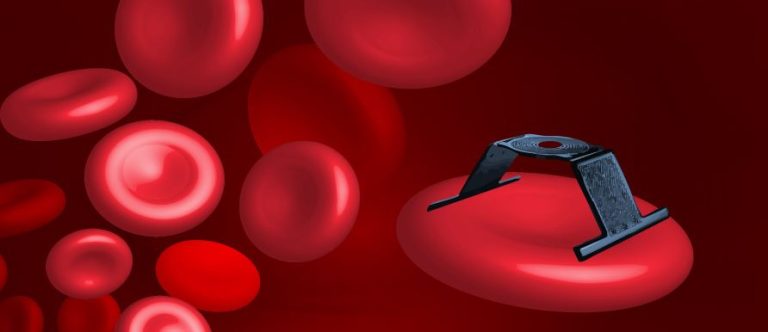
Scientists built a microscopic robot that can interact with light in useful ways.
Introduction
What do butterfly wings, peacock feathers, and chameleon skin have in common? These animals all have beautiful intense colors. Unlike the colors in a crayon, these colors don’t come from pigment. Instead, microscopic patterns and textures are responsible for the colors we see!
To understand why, we need to think about waves. How would you describe the difference between a small ripple and the big waves a surfer would ride? You might notice that ripples are close together, while ocean waves are far apart. The distance between the crests of waves is the wavelength. We see different wavelengths of light as different colors.
Waves change direction when they run into a narrow gap or a sharp edge. This is called diffraction. How much the direction changes depends on the size of the gap and the wavelength of the light. The tiny ridges and bumps on butterfly wings and peacock feathers cause diffraction and interference. This means that only a few specific wavelengths of light are reflected. Chameleons can go a step further. Inside chameleons’ skin there are billions of tiny crystals. The gaps between the crystals cause light to diffract. When the chameleon tightens or relaxes its skin, the space between the crystals changes too. This is what changes the color that we see!
Imagine if we could make a material that could change colors like a chameleon! We think that would be super useful. We decided to make a new kind of microscopic robot, or microbot, to try and do just that.
Methods
We designed a new kind of microscopic robot. It can be manufactured using the same technology used to make computer chips. The basic shape of the robots is simple. They are made out of flat panels joined by ultra-flexible hinges. On top of the panels, we printed a layer of special, super-tiny magnets, arranged in a pattern (Fig. 1). These magnets let us control the robots by changing the strength of a magnetic field. When we turn up the strength of the magnetic field, the panels pull together, bending in the middle. That way, it can scoot around, walking like an inchworm.
The robots are only about 10 micrometers (millionths of a meter) across. That’s small enough to fit on top of a red blood cell! The space between the panels is only about 1 micrometer wide. When we pull the robot panels together, it shrinks the space. This gap is what lets us control the diffraction of light. Similar to the crystals in a chameleon’s skin, we can adjust the robot until the gap is just right for the color of light we want to see.
Results
We performed a few experiments to see how well we could control the robots. We tested how fast the robot could move. One of the robots walked 3 times its body length in one second – a world record for robots of this size! They are also very maneuverable. To demonstrate, we guided the robot through a tiny maze (Fig. 2).
We used a laser to measure the gap between the panels. Light passing through a small gap diffracts, making a pattern of dots. We used a math equation to calculate the size of the gap based on the pattern of dots. This helped us figure out how precisely we could control the size of the gaps.
We made a few different designs, arranging panels and magnets into stripes, crosses, and triangles. We arranged them in patterns on a small square chip. When we put the chip in the light, we could see many bright colors!
Discussion
What can you do with a robot that’s as tiny as a cell? Scientists have lots of ideas. Micro-machines could carry medicines to specific places in the body, make new tools for doctors, or explore the microscopic environment. Our study explored a new idea: using microscopic robots to manipulate light.
We think that these little robots have a ton of potential. They can do more than change the color of light and move around. They can steer and focus light to make super sensitive measurements. We think that these microbots could improve the technology that doctors use, like microscopes and endoscopes.
It’s very hard to make a machine so small – and even harder to come up with a way to make it move in a useful way. The robots are too small to have an engine or a battery. Controlling the robots requires a fancy 3D electromagnet. To use the robots outside of a laboratory, we would like to come up with a simpler controller.
Conclusion
Inventors often look to Nature for inspiration. All living things have special skills that help them survive. We can learn a lot by paying closer attention to the natural world around us. What helps a tree be flexible and strong? How do microscopic features of animal skin, scales, or feathers change the way the animal looks and moves? These kinds of questions can lead to new ideas and inventions. What will you discover?