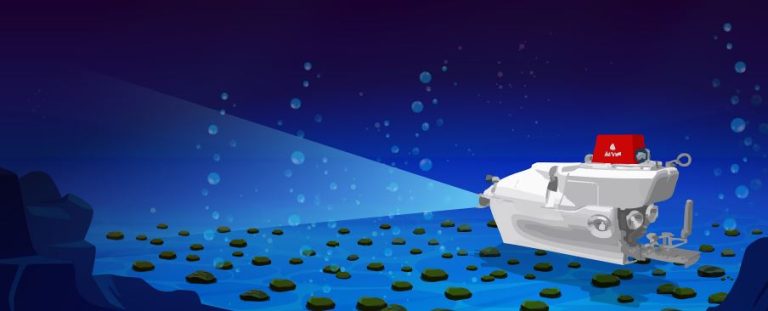
Researchers explored how oxygen could be produced in the deep sea.
Introduction
People say we know more about the surface of the moon than we do about the seafloor. The deep ocean is a hard environment to study. It is cold and dark. It is also under a lot of pressure. This means we need lots of technology to help us take samples.
One thing that we have found on the seafloor are polymetallic nodules. They contain layers of minerals and grow very slowly. They look like rocks, but they also have valuable metals in them like copper, nickel, and cobalt. These metals are used to make useful things like batteries. Large areas of the seafloor called the abyssal plains are covered with these nodules. But we don’t know much about the animals that live there or the chemical processes that happen.
We do know that these ecosystems don’t have as much oxygen as surface environments. Animals use oxygen when they respire. Bacteria also use up oxygen when dead things decay. Usually plants produce more oxygen using photosynthesis. But this process needs light, which is not present deep on the seafloor. We can understand more about this environment by studying respiration. So, we did some experiments to measure oxygen consumption under different conditions.
Surprisingly, our team detected oxygen production near the seafloor! We didn’t think this was possible. At first we thought something was wrong with our equipment. But we confirmed everything was working correctly. So, we wanted to know where the oxygen was coming from. This could give us more information about the availability of oxygen in the deep ocean.
Methods
We made our original measurements using a benthic chamber lander (see Fig. 1 on p. 1). This has a collection of chambers that are lowered to the seafloor. They can be pushed into the sediment to create sealed environments. Each chamber has an oxygen sensor, a stirrer, and a way to inject fluids. We injected things like algae, nutrients, and seawater. We left them on the seafloor for 48 hours and measured oxygen concentrations several times. We used the chambers a total of 16 times from May 2021 through September 2022. Our sample sites were in the Clarion-Clipperton Zone in the Pacific Ocean.
We had a few hypotheses to test about where this oxygen was coming from.
We accidentally added oxygen to our experiment.
We tested the benthic chamber lander in situ without injecting anything. We also took sealed samples from the seafloor. We looked at them back in the laboratory on our research ship. We checked to see if injecting fluids added oxygen or caused any leaks.
Organisms produced the oxygen.
We injected poison into three samples in the laboratory on our research ship. This would kill most organisms. Some microbes might have been able to make the poison safe for themselves, though. Then we measured oxygen in the samples.
Oxygen moved into the water from the sediment.
We made a profile of oxygen concentration right above and into the seafloor sediment. Oxygen should move from higher to lower concentrations.
Polymetallic nodules created oxygen.
We thought the nodules might produce enough voltage to break apart water molecules into hydrogen and oxygen. This process is called electrolysis. We measured the surface area of the nodules in our samples. We also measured the voltage at 153 sites on the surfaces of 12 nodules.
Results
Our tests didn’t show support for three hypotheses. We did not see any oxygen leaking into the benthic chamber lander. This was true at the seafloor and in the laboratory on our research ship. Oxygen was still produced when we added poison to our samples. We saw more oxygen in the water above the seafloor than in the sediment.
We did find support for one hypothesis. We saw more oxygen production when there was more surface area of polymetallic nodules (Fig. 2). We also found high voltage differences on the surfaces of the polymetallic nodules.
Discussion
Our results suggest that polymetallic nodules may produce oxygen. We think the nodules may act as a type of “geo-battery.” Electrolysis might be how this happens. Oxygen production is just a side effect! We need to do more tests to investigate.
Normally oxygen in the deep ocean originally comes from the surface ocean. This is where organisms use sunlight to make oxygen. Photosynthesis doesn’t happen in the darkness of the deep ocean. So, we use the nickname dark oxygen production for our findings. Our results suggest that dark oxygen production could provide additional oxygen for animals that live near the seafloor. We need to do more testing to know for sure. It also means that polymetallic nodules could be more important than we thought!
We set out to measure oxygen consumption on the abyssal plains. But we found oxygen production instead! Our results disagree with all other studies on oxygen in these areas of the ocean. We have many questions left to answer. Is dark oxygen produced in other areas of the Clarion-Clipperton Zone? Does dark oxygen production change based on environmental conditions? How exactly are polymetallic nodules creating electricity? We need more information to understand the impact dark oxygen production could have on deep ocean ecosystems. Fortunately we will be returning to run more tests!
Conclusion
When you discover something that doesn’t make sense, like we did, it is important to return to the scientific method. You can use it to help understand your world. Here are some places to start:
Talk ideas over with a friend or your family.
Come up with some hypotheses to explain what you see.
Design some experiments to test your hypotheses.
Make sure to keep an open mind about what you find!